Last week, I stumbled upon Stella Parks’ Impossible Pecan Pie in this post. I’ve never made pecan pie before and it caught my interest because it was a recipe that was found to be so finicky that she decided to pull the recipe from Bravetart and never publish it officially.
A recipe with a small margin for error, the potential to be greatly frustrating, and the perfect excuse to justify my impulse candy thermometer purchase?
I had no choice but to sign up.
After some sleuthing on Reddit, I found a recipe that someone seemed to have reverse-engineered from the video in a post.
It was time to get to work.
Science of Sugar and Caramel
So the hard part about making this recipe was the filling. Unlike other pecan pie recipes, this recipe requires no corn syrup.
Which begs the question, why is there corn syrup in pecan pie?
Before I dive deeper, this recipe did remind me of the last time I encountered caramel. A few years ago, a friend and I tried to make flan, albeit unsuccessful. The sugar crystallized as we were melting it down into a syrup to the point where it cooled so quickly that it hardened/thickened before we could coat the bottom of the glass pan.
Granted 1) we were partially delirious watching sugar melt at midnight and 2) I actually had no idea what was going on to recognize what was happening with the sugar at the time, I vaguely remember us scratching our heads and considering the flan experiment a bust.
So, this time, to avoid the same issue, I decided to do some prior research to try learning and avoiding what happened last time and found this post and this post.
If I ask the question, “hey, why did my sugar crystallize when making caramel?”, a good question to follow that up would be: “what is sugar?”
Granulated sugar is primarily sucrose, a disaccharide made from monosaccharides, glucose and fructose.

The reason why this is important to know is because sucrose molecules likes to bond with other sucrose molecules, especially in high concentrations, which leads to crystallization. The only way to discourage this crystallization process to add competing saccharides like glucose or fructose to prevent sucrose-sucrose bonding. How do we introduce competing saccharides?
- We add something with glucose or fructose or some other saccharide. Corn syrup is a big source of glucose. Honey is a source of fructose. Even milk or heavy cream contains lactose.
- We add an enzyme or some acid/heat to break down sucrose into glucose or fructose. This process is called sucrose inversion.
So, corn syrup is added to prevent crystallization. However, since this recipe does not require corn syrup, I think this recipe took the second option, which was to heat it to a temperature that sucrose inversion would happen. Caramelization then proceeds at ~340F when those broken down sugar molecules polymerize and make different brown caramel-associated polymers (caramellans), contributing to both its color and texture.

This recipe actually stops short of the 340F and pauses at 325F, probably because we are making liquid caramel, not hard caramel.
Great, it sounds like that all we need to do is load some sugar with some water in a pot on the stove and heat it to 325F.
There is one caveat. As the sugar syrup heats up, we run the risk of recrystallization where if sugar syrup splashes against the walls, there is the risk of the water evaporating and leaving behind sugar crystals behind. If these crystals, even a few traces, mix in the mixture, the rest of the mixture will rapidly recrystallize and harden very quickly and we have no caramel. The solution for that in the recipe was to be generous in brushing the sides of the pot with a wet pastry brush as the sugar heats up and dissolves in the water to never give the sucrose the chance to crystallize.
Long story short, from looking at what goes into caramel making, I figured I would have to babysit this pot as I made it.
Actual Making of the Pie
After making short work of a pie crust, I tried to be as diligent as I could with making the pecan pie filling. Initially, I was already a bit worried since I ran out granulated sugar and was forced to use the cane sugar that I only used as a pie weight substitute. After shoveling about 21 oz worth of sugar with some water and spending the next 7 minutes whisking it carefully with a fork, I got a small bowl and a wet pastry brush and tried to be diligent about washing down the sides of the pot to prevent any risk of recrystallization.
There were a few close calls but I was able to get it to the point where the mixture was able to turn into honey-colored liquid and get the temperature to crank up to 325F (thanks to my shiny new candy thermometer). I then added a stick of butter and stirred it into the caramel until it fully incorporated and let it cool.
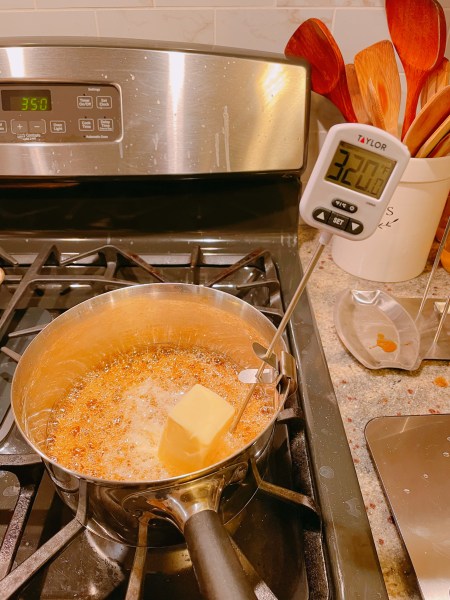
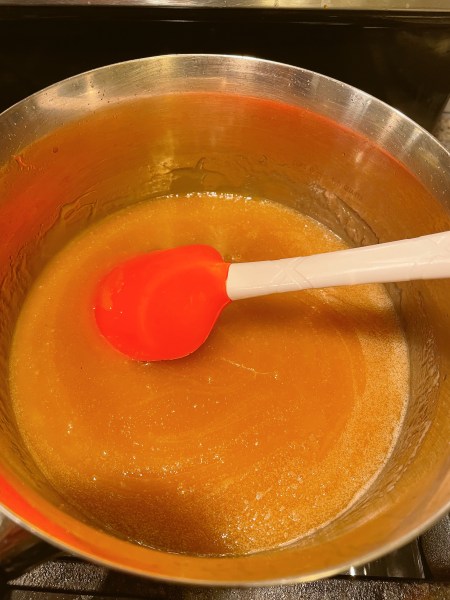
In the mean time, I whisk 4 eggs and some vanilla before folding it in with some pecan halves. At this point, the caramel cooled down to ~190F and I was able to pour it in (it was so glorious to see the liquid, not-gritty, gold pour into the mixing bowl) and mix with the pecans. I was a little bit uneasy when I noticed some bits of curdled egg but there was a distinct line in the recipe that mentioned, “you may notice a few specs of curdled egg but that’s a-okay. Really.”
Okay, Stella, I trust you.

The rest of the recipe was the short work of pouring the filling into the fully baked pie crust and baking it for about 45-50 minutes until it reached 210F. The crust was a bit overbaked (I wish I used a pie shield earlier than what the recipe stated) but it looked great otherwise.
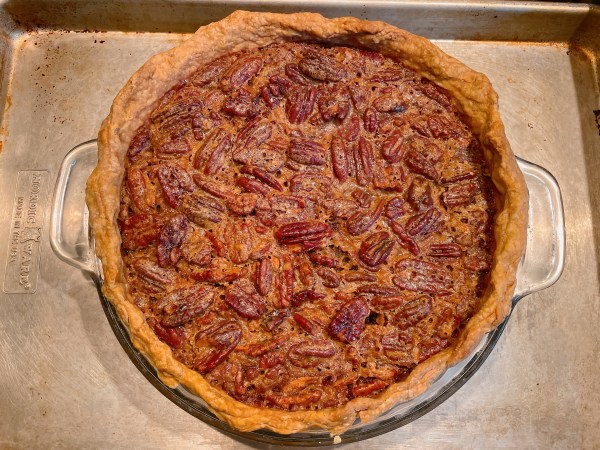
Overall, the pie was a success. My caramel didn’t recrystallize and it didn’t end with me trying to scrape out sugar crystals from the bottom of my pot. I was super happy. I was able to pull off the “impossible” pecan pie!

As for the taste, it was pretty decent. Though it is a solid pie, it was actually a tad too sweet for my taste, almost cloyingly so. I was a bit disappointed since I do like pecans and the hype and excitement over making it didn’t seem to match with the end result.
I brought this pie over for my office potluck where the response was a bit lukewarm. There was also a bit of an overabundance issue of pecan pie, as I’ve noticed that other people brought pecan pie too. I’m actually more surprised that I didn’t see pumpkin pie there, as that was the reason that I opted for pecan pie over pumpkin. Unless everyone else had the same idea. I also saw that the over-baked crust caused the problem where it was a bit hard to get a clean slice from the pie plate.
However, I seemed to get a more enthusiastic response for it when I brought over the leftovers to my Friday team meeting dinner, especially from one of the kids whose mother had to tell him to stop eating more pie after he ate a good amount of it.
My verdict? The process was fun, but I did think that it was unnecessarily complicated. From reading about the science, why not take advantage of the simple hack that corn syrup presents?
Anyway, I would probably not make this again but I enjoyed learning a bit about the science behind it and test-running my new thermometer.
7/10, I give it an “ehhh, yeah sure, okay.”

 Things Nicole Tried in 2024
Leave a comment