“Hmm, when we invited her over for dinner, I didn’t think that meant we’d be asking her to make our dinner. Something about this seems wrong.”
JK talking to his wife
Man, I really like soup.
This will be a quick post and the prelude to a series of catchup posts. Last week, I made galbitang, using this recipe from Korean Bapsang. I recently visited an old leader who ended up inviting me to stay over for dinner. The dish she wanted to make was galbitang. Through a weird turn of events and both her and her husband being busy with preparing for Sunday service, I ended up doing much of the grunt work . Earning my keep, I guess?
I was struck by its simplicity, how so little ingredients were required, and how easy it was to make in an Instant Pot. She noted to me that a dish like this would probably be $20 at a restaurant but making it at home cost her about $30 for multiple bowls. Intrigued by how straightforward the process was and how much more cost-efficient it was to make the dish at home, I decided to give it a try myself.
A couple weeks later, I got myself ~3.5 lbs of beef short ribs, garlic, ginger, 1 lb of Korean radish, some vermicelli noodles, and 1 onion. That’s like 6 ingredients.
First step was to rinse the pieces of meat (is this an Asian thing? Reminded me of the fact that my mom also rinses her meat when she cooks too) then to chop it up into pieces, which I made short work of with a cleaver. I then dropped the pieces in the pot and set it for “Pressure Cook” for 2 minutes to blanch them…which took about far longer than I expected. Because Instant Pots are always like that.
I felt like blanching them in a normal pot on the stove would’ve been faster.
In the meantime, I prepared the other ingredients and peeled the Korean radish–initially with a peeler before getting impatient and switching to a knife to slice off the outside skin and cutting it into 1/4″ inch thick pieces. Before making galbitang, I never handled Korean radish and was surprised by how grainy/mealy the outside skin was. This vegetable does not want to be smoothly peeled. Don’t waste your time with a peeler, just use a knife.
After the initial “2-min” pressure cook time, I switched out the murky water then replaced with new water and dumped the rest of the ingredients into the InstantPot. I also didn’t have that Korean soup soy sauce and I wasn’t going to buy a whole bottle of that for this purpose so I added like three tbsp of normal soy sauce, along with some fish sauce (because why not). Ignoring whatever cultural cooking crime I just committed, I moved on with my life and pressure cooked this for 35 minutes.
Knowing this would take way longer than 35 minutes, I was able to go for a run and take a shower before the pressure cook period was done. It smelled great.
But I wasn’t done.
The instructions say to strain out the vegetable aromatics from the stock and to throw them out and remove the short ribs. However, I really didn’t want to try figuring out how to lift a likely hot and heavy Instantpot and pour it successfully into a strainer with a large stockpot then to transfer everything back to the Instantpot. Too.much work.
So instead, I went fishing with a strainer. Through the same principles of extraction, I went a couple of rounds by scooping through the soup with a strainer, tossing any spare ribs and scraping out whatever vegetable bits I found in the pot. I don’t know if this was any faster than what the original instructions called for but hey, less hassle and less dishes/pots to clean.
I then tossed in the radish to cook for 10 minutes on saute mode and added some vermicelli noodles (because I didn’t have dangmyeon noodles) at the last minute.
The amount of time it took for me to finish the dish was another reminder to me that the name, Instantpot, was a misnomer. Honestly, the time needed to cook with an Instantpot was probably comparable to cooking it on stovetop.
Anyway, so with some rice and topped with freshly grounded black pepper and green onions, this soup was like a comfort food, great on a cold day. My base instinct as a soup guzzler was well-pleased with it. Taste was not too different from what I remember galbitang tasting like. The soup was a bit oily, probably due to the fact that I was too lazy to remove the fat trimmings from the short ribs. It was also much darker than what I expected, probably due to the use of normal soy sauce. Also I don’t think it’s a traditional move to add black pepper to galbitang but it taste amazing with it.
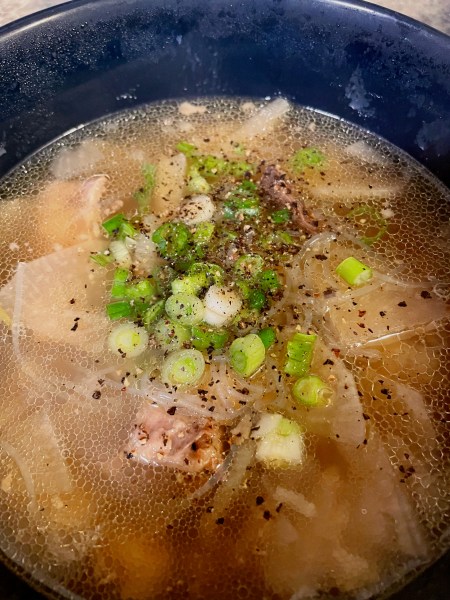
Overall, great hands-off recipe if you’re not in a rush and really easy to make. Very excellent meal to feed myself with for the next few days if I wait.
I like soup.

 Things Nicole Tried in 2024
Leave a comment