I’ve been trying to get back into the mood for cooking stuff, where it feels like my bandwidth is more limited these days to cook or bake anything, whether it be with being too busy with work, something ministry-related, or if a friend invites me over for dinner.
The third one I always feel a bit weird about–sounds like a first world problem where I can’t cook at home because someone invites me over for dinner first.
So basically, I have too many friends who want to feed me.
Maybe I just have to get more aggressive about inviting people over first. Can’t believe that’s an actual solution to this issue.
Hrm.
Though on a more serious note, I think the way that life happens, you have less and less time to yourself as you get older.
Anyway, for my homegroup had a potluck last week. I wanted to try to make something more than just picking up drinks or dessert on my way back home from work as I usually do when I’m pressed for time. I also wanted to go back to using my cookbooks again. So I decided to make a recipe titled, “Rice Cakes with Pork, Shrimp, Pine Nuts, and Vegetables” from J. Kenji Lopez-Alt’s The Wok. Because I didn’t want to go hunting down for every single ingredient in this recipe, I made some substitutions and really made “Rice Cakes with Pine nuts and Other Stuff”.
I first got inspired to make this dish when I found some leftover ricecakes in the fridge that a housemate, who made a kimchi stew, didn’t use last week. I also never cooked with nuts in a stir fry and it intrigued me.
The inspiration behind this dish comes from a Korean dish known as gungjung tteokbokki, which translates to “royal tteokbokki.” It’s a more mild, lesser known cousin of the more famous, traditional, red, spicy tteokbokki, looking something like this. I’m not Korean enough to know more about this.
As a tangent (or maybe not, because this will prove to be important later), I also realize that there are different types of rice cakes for a good reason. This recipe calls for garaetteok, which is the cylinder version of rice cakes, which is used in tteokbokki or other stir-fries. There is another version of rice cakes called, tteokguk, which was the thinly sliced oval version of rice cakes and more reserved for soups or stews.
So, I had the latter option, not the cylinder version. I did not know there was a difference between the two rice cakes and thought they could be used interchangeably but cooking this dish served as a learning experience to me.
You’ll see.
The Part where I talk about making this
Half of the work for this dish was predictably gathering my ingredients and prepping them. Something I appreciate about this dish is that it is, at its core, just a basic stir-fry and a lot of components can be switched out for something else. It’s a blueprint and something that I can potentially see myself reusing if I get more reps in.
Ingredients I gathered for this were:
- Pine Nuts
- 1 lb of rice cakes
- 1 box of firm tofu (16 oz)
- 3-4 bok choy bois
- 4 scallions
- 5 cloves of garlic
- 4 oz of hon shimeji mushrooms
- ~5 oz of sugar peas
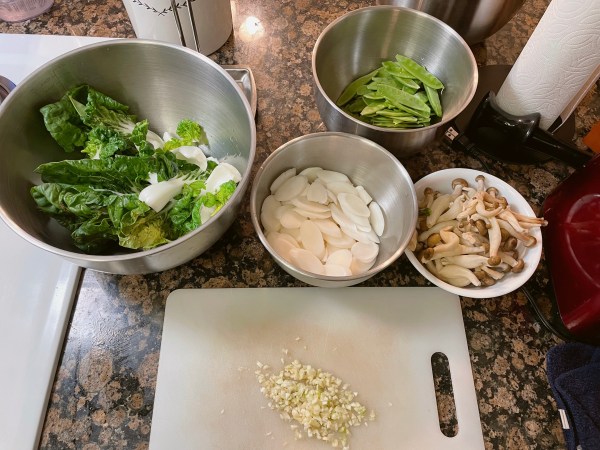
A majority of these ingredients can be swapped out for something equivalent in the fridge or we can play around with the ratio of veggies to meat.
Something that Kenji mentions in his book is that a lot of stir-fries need to have all ingredients prepped and ready to go to throw into a wok and take out at a given moment.
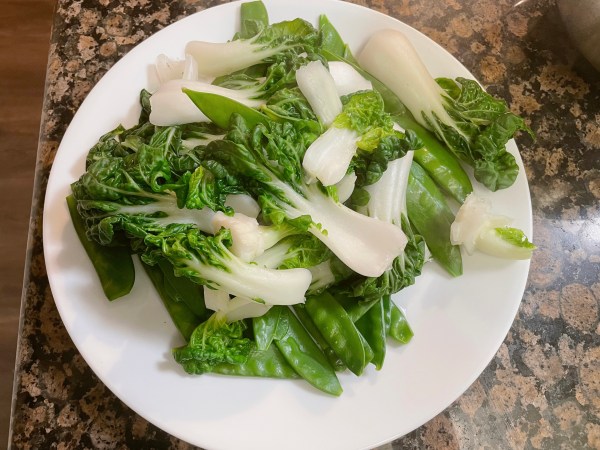
First order of business was to soak the rice cakes. Then, I moved to blanch the veggies in a wok of boiling water. I blanched the sugar peas, then the bok choy. I let this boil for about 2 minutes but in hindsight, I should’ve boiled both veggies together for even less time. I fished out the veggies with a strainer but should’ve drained the water in the sink because I didn’t need the water anymore at that point.
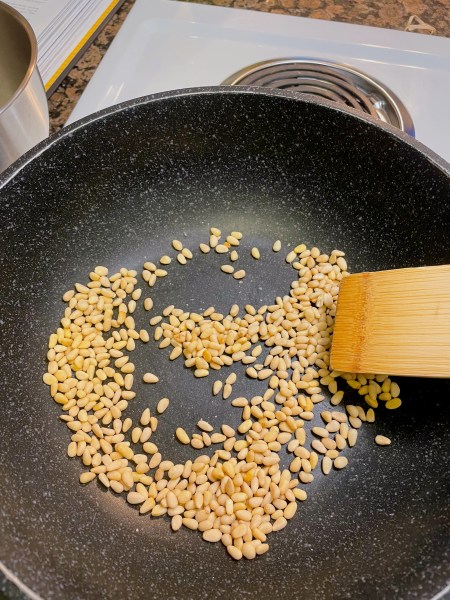
Anyway, next order of business was toasting the pine nuts, which was reminiscent of the time I roasted some pine nuts to add to some roasted cauliflower. Except this time it’s on a stove, not an oven, this time. I toasted them until aromatic and darker brown.
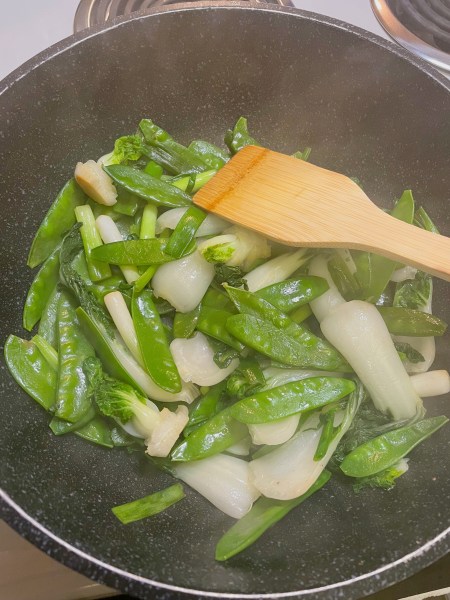
I added this to a bowl and then stir fried the bok-choy and sugar peas along with the scallions until browned in some spots before transferring it to the same bowl of pine nuts.
The mushrooms were next to be stir-fried. Curiously, it released quite a bit of water when cooked. I fished out the mushrooms and added that to my bowl of cooked stuff but wanted to keep the mushroom liquid for umami reasons.

I shouldn’t have kept the liquid, I was greedy.
Anyway, so I added the tofu and garlic. I realized belatedly that garlic can’t stir-fry well in a pool of mushroom liquid. Welp.
At a certain point, I add everything (including the rice cakes) back in and kinda let that all stir-fry together over the next several minutes after adding some soy sauce and sesame oil. I was looking for signs of charring but it was pretty slow. I also realized that rice cakes overcook pretty easily too. Maybe it was due to their shape, but the oval-shaped rice cakes softened pretty easily and started sticking to the bottom of the wok. My theory was that I needed to keep things moving when stir-frying or I soaked the rice cakes for too long. Maybe I have to use the cylinder-shaped rice cakes next time.
It was too much food in one wok. so everything ended up just overcooking most unfortunately. The vegetables went soft. Texture-wise, I was less than pleased.
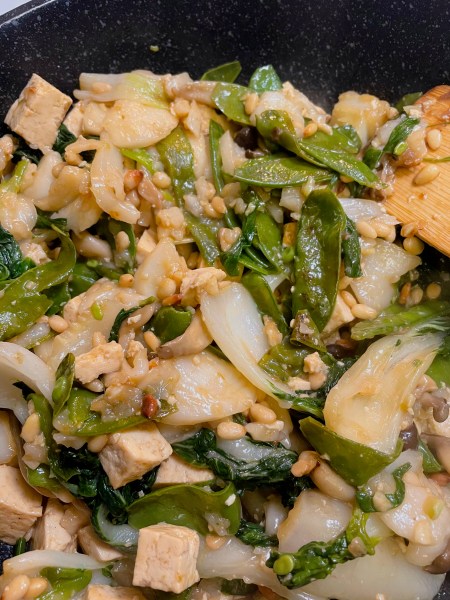
Overall, the taste was pretty mild with the soy sauce, not overly salty. It’s the taste of a solid weeknight stir-fry. I like the nuttiness and difference in texture that the pine nuts add. Honestly, I just really like pine nuts. I might repeat this dish, just to learn from previous mistakes I’ve encountered this time around.
I also realize how long it has been since I’ve last cooked a proper meal. My muscles for moving around and working in a kitchen has atrophied; I’m moving much slower, which is a bit frustrating but makes sense. I’m cooking a lot less often. I need to put in the reps again and practice maneuvering around the kitchen faster again.

 Things Nicole Tried in 2024
Leave a comment