The second cookie I decided to make were Kristina Cho’s sesame caramelized white chocolate chip cookies, recipe found here.
To be honest, I forgot what my thought process was for settling on these cookies for any reason other than making something a little more adventurous. For some context, if I consume enough sesame, it could be strong enough to trigger an allergy response the same way I might react to peanuts.
Hmm.
Anyway, I guess there must’ve been something about working with sesame and making caramelized white chocolate that appealed to me enough to ignore the actual potential hazard to my health.
Caramelizing White Chocolate
White chocolate gets a bad rep for being overly sweet. At times, it may seem like a controversial topic starter if one were to say that white chocolate was their favorite type of chocolate. White chocolate definitely receives less love than its dark or milk chocolate counterparts.
The last time I used white chocolate was for matcha white chocolate cookies. I aimed to do something a little different for this batch. For the same reason why matcha works well with white chocolate, the sweetness of white chocolate can be balanced well when paired with something nutty and maybe even slightly bitter. Caramelizing the white chocolate takes that flavor to a different place, giving it a butterscotch note.
This is what one calls “blonde chocolate”. A bit into chocolate lore here and here but Valrhona Chocolate first tried to introduce blonde chocolate as a thing back in 2004, actually two years after “white chocolate” was given its first proper definition by the FDA.
Like most things, it appears that blonde chocolate was created on accident as a result of melting and leaving white chocolate to heat overnight.
There’s a bit of discourse on whether or not “caramelized” is a misnomer, as this chocolate seems to be browned by Maillard reaction, rather than caramelization. Both are types of non-enzymatic browning but Maillard reaction involves the reaction between sugars and proteins while caramelization involves pyrolysis of just sugars. At its low temperature, it is more suspected that it’s the Maillard reaction that causes white chocolate to turn into its caramel-brown color–browning between the cocoa butter/milk and the sugars, rather than between the sugars.
But “Maillard browned white chocolate” doesn’t sound as good as “caramelized white chocolate.”
For my first step, I dumped about half a bag of white chocolate chips onto a baking tray at 270F. This ended up being a tedious process of checking on it every 6-8 minutes, and scraping it off the baking sheets to mix it. The texture appeared chalky as the chips melted and I was initially very dubious to see where this. would go. However, over the course of an hour, the chalkiness of the melted white chocolate slowly went away and smoothed out into something more spreadable, gradually changing to its caramel-like color.


I then spread it out with a butter knife and left it in the freezer to freeze. After about 15 minutes, I took out the now hardened “caramelized” white chocolate and broke it into small chunks to be incorporated into cookies.
Making the Cookies
Putting together the cookie dough for this was standard, as making any other cookie.
I did have a bit of a tiff with the microwave when microwaving butter and learned the unfortunate lesson of why it’s better to melt butter in a stove. American butter, containing amounts of water, was a ticking time bomb in the shower.
It’s not fun cleaning a microwave after midnight.
The recipe called for a lot of tahini paste to the point where upon mixing in the dough, it appeared very liquidy. Because I knew that I would be rolling up the dough later, I decided to later change the recipe by adding more flour until it got to the point where I could roll the dough into small balls. I then folded in the white chocolate chunks.
I let the dough chill in the fridge for the next 30 minutes before proceeding to roll up each ball and top each with sesame seeds and a larger chunk of white chocolate. I then baked these cookies for roughly 12 minutes until I saw the edges brown.
If you didn’t remember what I mentioned about how strong sesame could be to the point of potentially triggering an allergic response for me, I didn’t remember either and underestimated the power of the sesame. These cookies were really sesame, where the overpowering smell of these cookies baking in the air ended up making me choke and knocking me out on the couch for a short bit.
Again, not sure why I decided to make these cookies.
After letting the cookies cool, like the way most cookies do, they thickened to a more acceptable baked texture.
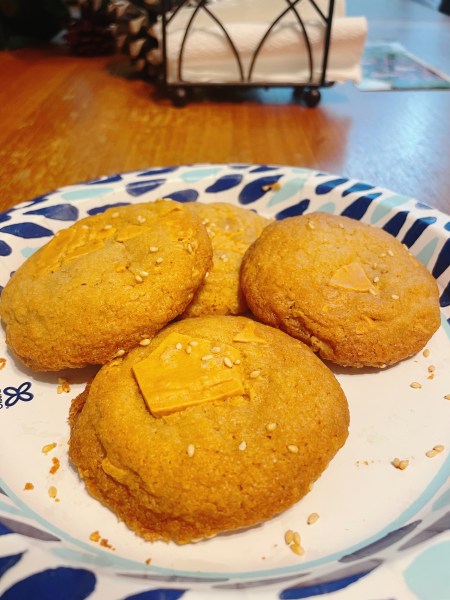
Overall, these cookies smelled a lot stronger than they taste, though the tahini still tasted pretty strong. I was able to eat one without any immune response issues.
To quote one mentor I visited, she said, “wow…these cookies taste so strong, it’s almost peanut buttery.” Tahini was the dominating taste. Though I could taste the butterscotch sweetness from the white chocolate, it was drowned out by the tahini.
This cookie wasn’t bad but needed a bit more flavor balance–maybe by adding less tahini (~25-30% less) and pairing the butterscotch with a bit of salt to help bring its flavor notes more up to the surface.
Arguably, I think the flavor balance would’ve been fine if I used regular semi-sweet chocolate, which probably tastes a little bolder than white chocolate.
I’m just glad I didn’t overbake the cookies this time around.

 Things Nicole Tried in 2024
Leave a comment