Following something else of what I’ve started from last year, I volunteered to make Christmas dinner for my family. Though less involved than a prime rib roast, the porchetta was the dish I settled on making to be the Christmas main. I chose this mainly because this was a non-Asian dish (a nice departure from my family’s usual diet and was something that my mom could not take over in the way that I know she likes to do when working in a kitchen.
As much as a prime rib roast is considered top-tier for roasts, J. Kenji Lopez-Alt makes an excellent case for pork being a strong contender to challenge that rib roast for that position. His recipe, taken from The Food Lab, is also what I decided to go with for approaching this recipe.
So the first ingredient I had to obtain was a huge slab of meat–a slab of 12-15 lb pork belly, to be exact. Thinking that was a lil excessive, I decided to scale things down to 7-10 lb instead.

My mom, who was helping me shop for ingredients, still balked at the size. The butcher at the Asian market she bought the slab from gave her dubious looks. She bought me an 8.5 lb pork belly slab, with dimensions close to 10″ x 20″
It was truly a sizeable boi.
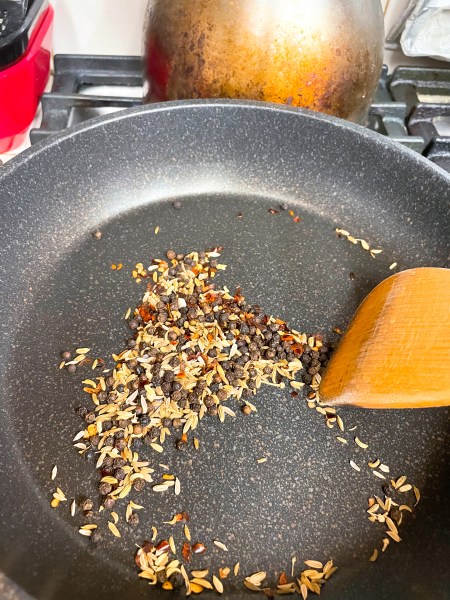
We first started by toasting the spices on a pan and then subjecting to the brutality of a mini food processor, which unexpectedly sent spice dust flying, much to my mom’s dismay. We then transferred these spices to a mortar and pestle to grind up the remaining black peppercorns and set that to the side. Though I already scaled down the rest of the recipe’s ingredients with respect to the size of the Big Pork Boi, I did not scale down the amount of garlic needed because everyone knows that the garlic amount in any respectable recipe is outside the laws of culinary reason. I made short work of the garlic with the food processor.
We then scored the underbelly with a diamond-like pattern before rubbing in salt, the minced garlic, and spices/herbs. At the request of my mom who informed me that my dad hates rosemary, I decided to replace rosemary with thyme instead.
With some considerable manhandling, we first rolled it up width-wise before I double-checked that it was supposed to be rolled up length-wise, which is quite long. After rolling it the correct way, we moved to tie the roll down. At this point, my mom went rogue and took matters into her own hands and wrapped the roll down with twine, not in the uniform increments that Kenji mentions but instead, in one continuous spiral-like fashion.

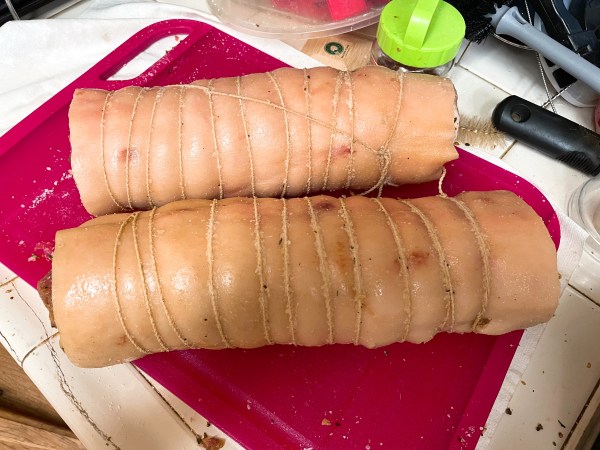
It was efficient and got the job done. I had nothing to complain about.
We rubbed the outside with baking powder and salt before letting the piece of meat dry-brine in the fridge for the next 16 hours.
Learning from my mistakes from last year, I invested in a digital probe meat thermometer. I decided to roast one of the rolls at 300F. Around two hours, it reached 160F. The skin looked like it was slowly drying out. For the ends that were already cooked, the meat was quite salty but good. You can definitely taste the herbs.
I quickly diced up some potatoes and covered it with the pork belly drippings and some leftover bacon fat (taken from a separate dish my mom made) before seasoning it with some salt and pepper and adding that to the pork belly dish.
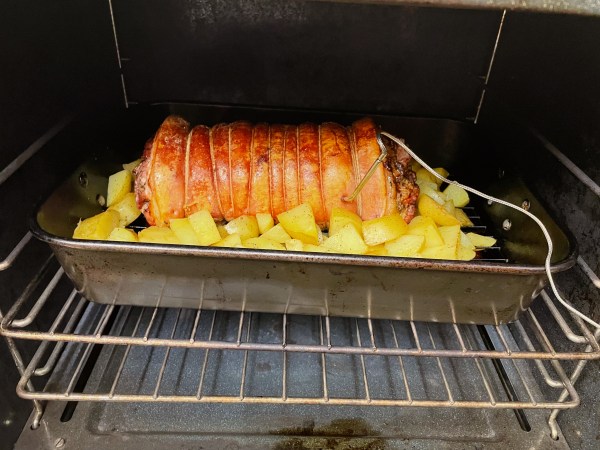
My mom felt a little nervous about the cooking time because it was already at this point that the pork was already cooked. At this point, it was hard for me to see why I would need to cook this further either if it already reached food safe temperatures. I let it cook for another hour (rather than the two hours mentioned in the recipe) before covering the ends of the roll and raising the temperature to 500F to make the skin crispier and the potatoes more charred.
In the meantime, I roasted some brussel sprouts and shallots, seasoned with some salt and black pepper and tossed in more bacon fat. Unsurprisingly, this turned out pretty good. However, I learned that my family was not a big fan of bitter vegetables and did not care for these brussel sprouts as much.
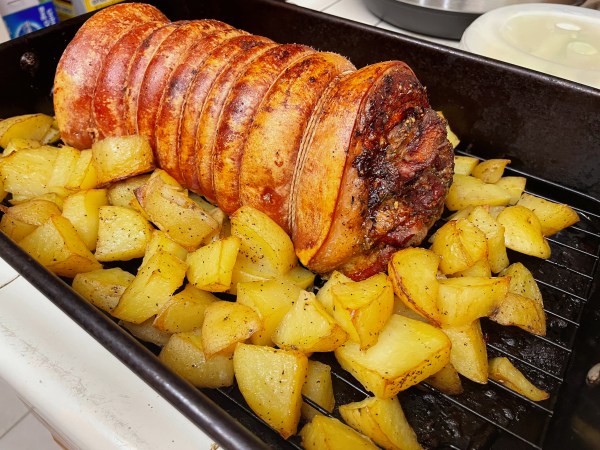
The pork belly, being a fatty meat, led to the meat staying moist. While the ends were saltier, the inside meat were pretty well seasoned. The skin was crisp while the inside was tender, both parts quite flavorful. After letting it cool for 5-10 minutes and then unwinding the twine from the porchetta, I cut the roll into 1-inch increments. The potatoes, when roasted in the appropriate animal fat, predictably tasted pretty solid too.
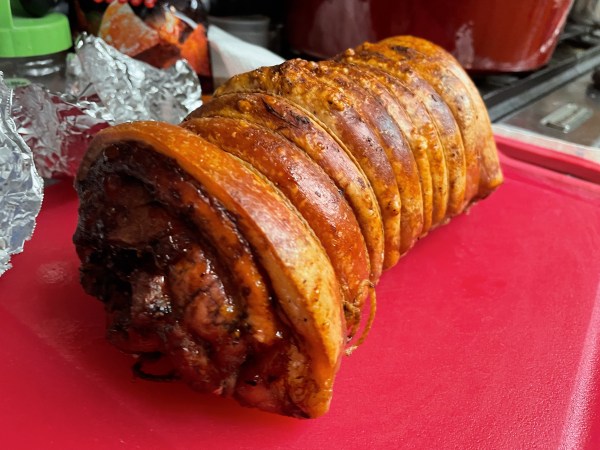
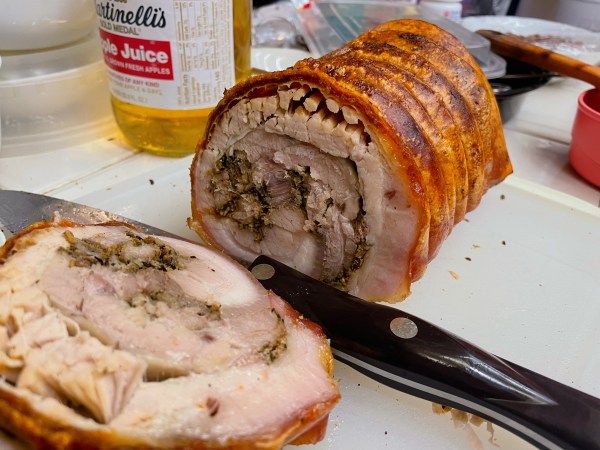
My family enjoyed it. Even my brother asked for seconds, which is not usually common.
Again, this was a less involved process than the prime rib roast from last year. The most prep I had to do was seasoning it prior and rolling it into its roll form. I appreciate that this recipe was straightforward and required minimal watching, once it was in the oven. Having the thermometer this time around made my life easier as well too.
As fancy as the name sounded and even the idea of a rolled piece of meat might conjure some fancy impression, this recipe was really simple and an example of low effort with high reward (given with enough time). Pork belly was definitely cheaper than a prime rib roast. Pork belly is also a meat that is pretty dang forgiving and allows for a considerable margin of error. Also, pork belly. It’s going to be flavorful, in by itself.

However, something we’ve noticed was that the bottom of the porchetta roll, the skin still stayed soft–probably because it was less exposed to the heating elements. This led to the bottom skin getting a bit rubbery and thus hard to eat. Since we still had one more roll, something that my mom and I tried to do was rotating the roll half-way through as we roasted this one, which seemed to have helped. My mom, who really likes crispy skin, suggested putting it under a broiler to make the skin even more crackly. I was bit afraid of burning it but decided to try putting it under for three minutes (my mom wanted to put it in for longer) and the skin blistered very quickly as things do under the broiler. While the skin was very crispy, I found it too crispy and thought that the broiler was overkill.
Things to note, I suppose. But overall, the flavor was good and ended up being a satisfying Christmas meal.

 Things Nicole Tried in 2024
Leave a comment