It was Pi Day 2024 this past week. We’re already in mid-March, crazy to see how time flies since the start of this year.
While I know I mentioned February being a bit of a busy month, I find that things haven’t completely slowed down, especially with Easter being around the corner. While I can’t say I feel less harried than where I was in February, I at least can say that I am somehow still here, holding on. Doing my best to hype myself up for it.
Anyway, so, every year, my workplace has a pie competition and I try my best to submit something for it. I always had a soft spot for pie. This year, I wanted to try something a little different. Usually, I try to be a bit strategic in what I decide to make for a baking competition with a general gauge on what my audience (the rest of the coworkers) like. Sometimes, I’m successful. Other times, I have not been. This year, I decided to do something a little different and try making something that I would personally like.
Pandan has been making a bit of a comeback in my life. There was a bit of time ago where I sworn off of pandan and ube after consuming many, many baked goods containing this flavor. Perhaps, absence makes the heart grow fonder because I found myself craving for it lately. Making kaya jam last year was essentially an argument for me to consider pandan again and it worked.
Thus, I decided to make a coconut pandan tart. I don’t have an exact recipe for this but I did adapt Claire Saffitz’s pastry cream and shortcrust pastry recipes from Dessert Person to fit this bill, along with having some inspiration from Jun and Tonic’s blog post on the same idea.
This is also the first dessert that I’ve made this year, which is crazy. Post-Freddy Panchito era is a trip.
I made this tart in three steps:
- Make tart crust
- Make coconut pastry cream
- Make pandan coconut-based whipped cream
Tart Crust
As mentioned previously, I used Claire Saffitz’s recipe for a pâte sucrée, which is not new to me. I enjoy the toasted nuttiness from the almond flour she adds to her crust, which usually does a good job of balancing the filling if it happens to be too sweet. However, the process certainly felt new as I realized that it has been a very long while since I last made a full 9-inch tart.
With some goofs along the way that include forgetting to prick the bottom of the tart before baking and shaving off the overhang dough when placing the dough in the pan, I made short work of this crust. Baking this took surprisingly longer than I expected where the sides cooked much faster than the bottom. This resulted in a pale, barely golden brown bottom with quite brown sides.
I also forgot to trim the sides before baking it so I did not have excess dough to patch the inevitable cracks–leading me to make a makeshift substitute with a mixture of flour and softened butter, which seemed to do the job.
While not the most terrible thing, it was not ideal.
Due to how delicate this crust was, I was not confident in my ability to remove the bottom and thus left it attached to the tart after removing the tart ring.
Coconut Pastry Cream
This ended up being much more straightforward than I expected, and reminded me of the time I made kaya jam. Claire Saffitz had a coconut cream variation of her Very Solid Pastry Cream That I Like so I decided to go with that with a few adjustments. I skipped the step of reducing the coconut milk and decided to go the route of using a can of coconut cream instead and used a ratio of 1:1 milk:coconut cream. I also replaced the sugar with 90% of the expected amount using palm sugar. Because this was also a pie filling, I increased the amount of cornstarch by 20%.
When trying to gather the right amount of palm sugar, I was reminded of how solid a block of palm sugar was as I was stuck, hacking away at it in thin slices with a knife. I felt like a rat trying to slice off pieces of cheese from a hard wedge. Except no, there was no cheese. Just sugar. This step represented my arm workout for that day.
The first step involves whisking the eggs, sugar, and cornstarch together. When using granulated sugar, I usually expect to see a pale yellow ribbony mixture. Using palm sugar, the mixture turned a light brown, not too disimilar from the color observed with the kaya jam.
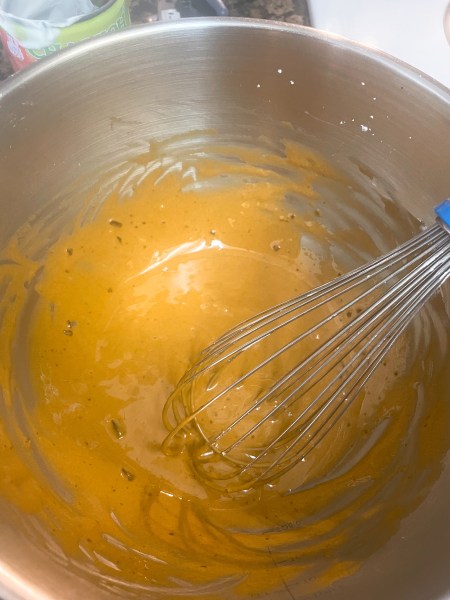
It smelled great.

After letting the milk-coconut cream mixture simmer on the stove, I tempered the egg mixture and poured everything back into the pot and cooked it for about 7-8 minutes until it had the custard-like texture and slow thick bubbles popped from its surface. I suspected that this process actually took me a little faster because coconut cream is pretty thick to begin with.
I then sifted through this mixture and whisked in 6 tbsp of butter. I then set it aside to cool for the next two hours. I did a little taste test and realized that it tasted like a rich kaya pudding! For the same reasons that I enjoyed the kaya linzer cookies, I enjoyed the taste of this filling–very coconut-y, a tad creamy, and not super extra when it came to flavor. It was also a tad bit on the sweeter side, which made me want to consider adding less sugar, maybe closer to 70% of the original one, next time. I noticed that Jun and Tonic’s recipe involved baking the filling directly inside the unbaked tart shell but I didn’t want to do that. I also realized that it tasted quite rich and I needed something to balance it out. I would want my topping to be light.
Pandan Whipped Cream
This came together pretty quickly (5 min). I wanted to do a coconut-based whipped cream to get rid of the remaining coconut cream I had left. The good thing about coconut cream is that it is inherently more stiff than heavy whipping cream, meaning that it could keep its shape more. I chilled the coconut cream for about 30 minutes before getting started.
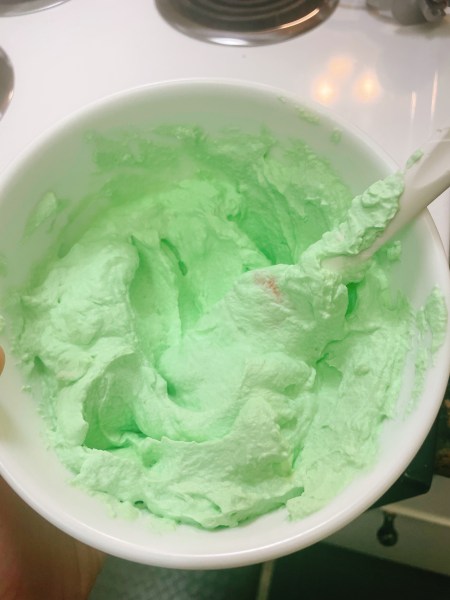
I started by beating 1 cup of heavy cream until thickened with barely soft peaks then added 1 cup of chilled coconut cream, along with 1/4 cup of powdered sugar and ~1/2 tsp of pandan extract. It whipped up to stiff peaks easily. The whipped cream was light and not too heavy on the tongue, I think it would’ve benefitted if I added a pinch of salt to bring out the pandan flavor more. If I was more extra and less lazy, I would have also made my own pandan extract with pandan leaves.
Overall
I put it together by layering the kaya custard first before topping it with whipped cream.
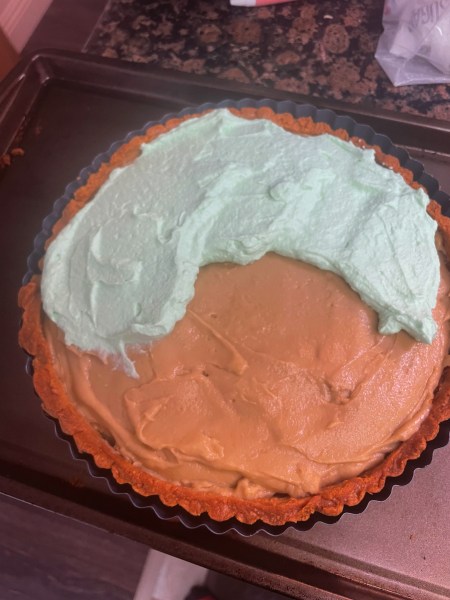
I actually felt pretty satisfied with how this tart came together. The kaya custard, while a tad on the sweeter end, was something I was pretty satisfied with and it was balanced out by the lightness of the pandan whipped cream.
I would make this again with some tweaks to the crust, the sweetness of the custard, and the pandan flavor of the whipped cream.
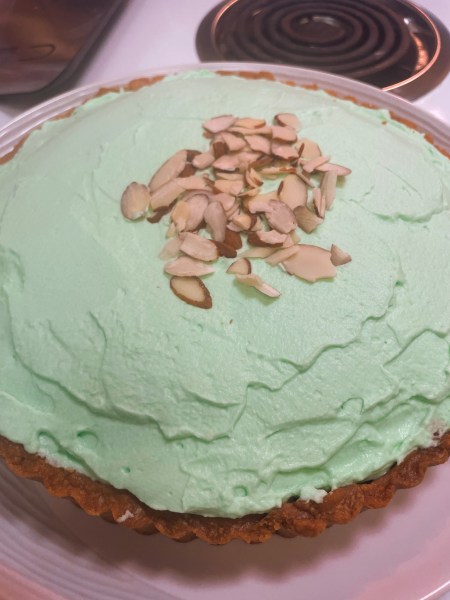
I also ended up winning second place at work for this tart so that was pretty sweet.

 Things Nicole Tried in 2024
Leave a comment