Another catchup post but a month ago, my leader finally contracted COVID for the first time after dodging it for the past three years. She realized she tested positive upon coming back from a trip for her 15th wedding anniversary.
Happy anniversary, here’s a case of COVID.
Thus a food rotation was set up for her and her family. What I decided to make was shio ramen with chicken chashu, the recipe taken directly from the book, Japanese Soul Cooking by Tadashi Ono and Harris Salat. This book was a gift from a friend and I was finally excited that I had the chance to make something from it. It ended up simultaneously being less and more work than I expected.
Which doesn’t make any sense but you’ll see what I mean in a bit.
Making the Shio Ramen Broth
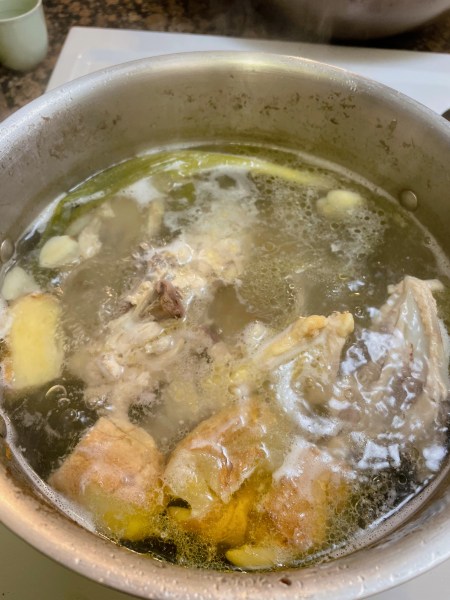
I first started by rinsing the chicken bones (Njiya sells chicken bones, that was something new for me to learn) then putting it at a simmer, along with some crushed garlic and ginger and a scallion. I let that simmer for the next two hours and left it alone, occasionally skimming the scum off. Because I realized I would make slightly less than 2L of broth, I topped it off with some chicken broth I had in my fridge and added some dashi for extra flavor.
So this broth was the base but the tare, or the concentrated flavor essence, is what defines it as a shio ramen, versus a shoyu ramen. I started making the shio tare by simmering garlic, ginger, and scallion in sesame oil for two minutes then added sake and a crap ton of salt.
So much salt.
A whole 1/4 cup of sea salt.
Welp, shio ramen is salt-based.
I then removed the chicken bones, ginger, and garlic from the broth. For 2 L of broth, I added 3/4 cup of tare to bring that saltiness flavor.
After adding the tare, the broth looked like this:
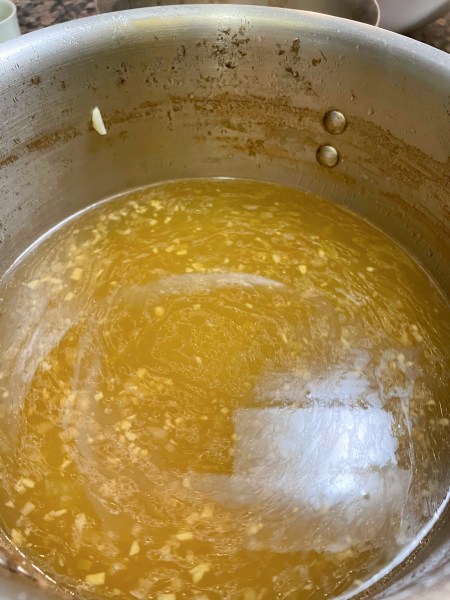
It was flavorful but quite salty. Also, while chicken is good, chicken is still inferior in terms of broth taste, to pork. Also, in hindsight, rather than dumping the tare all in, I would have added it in increments to the desired saltiness.
Making Soy Sauce Eggs and Chashu
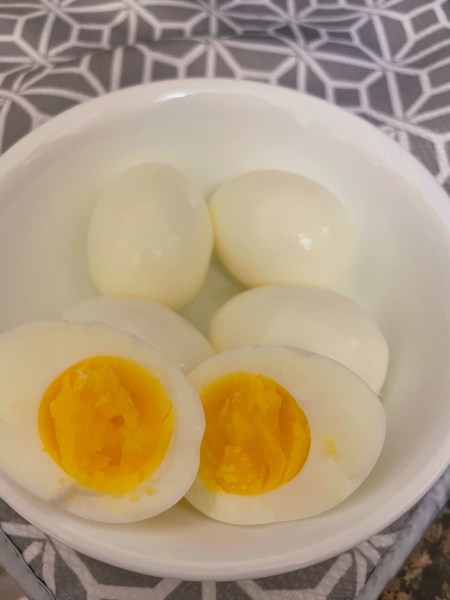
The soy sauce eggs (ajitama) were the first thing I made, starting the night before. I made the marinade with everything except for the sake (which I didn’t have at the time)–soy sauce, mirin, garlic, scallions. I then made some soft-boiled eggs by simmering some eggs over medium heat and swirling them in water. This is interesting but I learned that the swirling motion helps loosen the egg whites from the shell while cooking so it’s easier to peel as well as help the yolk set more in the center (aesthestic reasons). After seven minutes, I rinsed it under cold water and peeled them before placing them into the bag of marinade to marinate overnight.
The recipe that the book provides for chashu but because my leader didn’t eat red meat, I substituted it with boneless, skinless, chicken thigh meat. I rolled each chicken thigh tightly and placed it with the roll crease on bottom. The idea was to bake it so it would bake and stay in its rolled form. Another option would have been to tie it with twine, but I didn’t have twine. Instead of boiling this meat (which would’ve made the meat easily unravel), I ended up seasoning it lightly with black pepper, salt, and shichimi togarashi, then baked it at 425F for 20 minutes, flipping at the half way mark. I then let it cool down for a bit before placing it with the soy sauce egg marinade for at least an 1 hour. Then, I cut it into chashu-like slices.
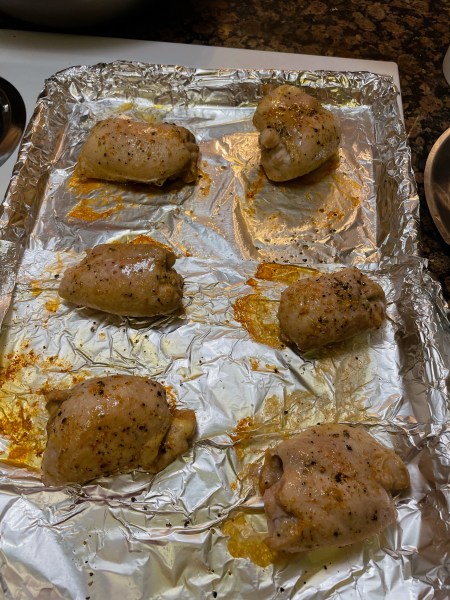
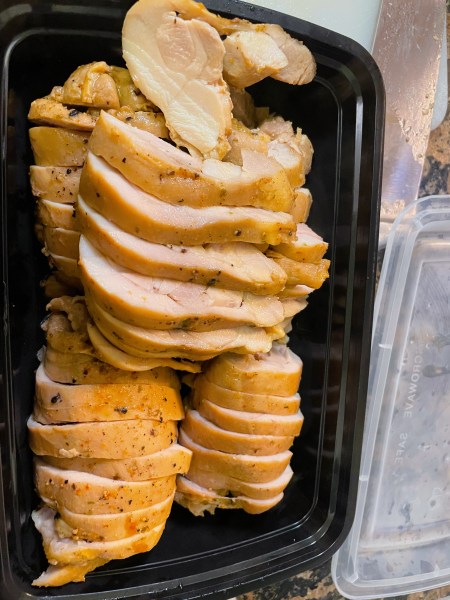
This meat was pretty moist and tender, I would definitely make this again.
Making Everything Else
Other than the broth and the protein, what else goes into ramen?
Well, there’s ramen noodles and some other stuff too but that came together pretty quickly, which included
- Cabbage
- Mung bean sprouts
- Ramen noodles (6 oz servings)
After blanching the cabbage and mung bean sprouts, I made the noodles. In my miscalculation, I saw that 4 packages of ramen noodles were needed but missed the part that this was assuming the package was 6 oz. I ended up cooking 2 packages of 32 oz.
Doing the math, I calculated that this is way too much noodle.
After experiencing some brief war flashbacks of boiling a lot of noodles in a tiny pot and learning what the power of starchy water was like, I tried my best to spend the next minute cooking and separating too many ramen noodles in a too small pot.
[i later used the excess ramen noodles to make chow mein later]
For ease of transportation purposes, I did not assemble the ramen for my leader but packed all the individual components–noodles, bean sprouts, cabbage, chicken, and egg–to be put together in a ramen bowl.
As for me, I did my best to make a picturesque bowl of ramen as seen below.
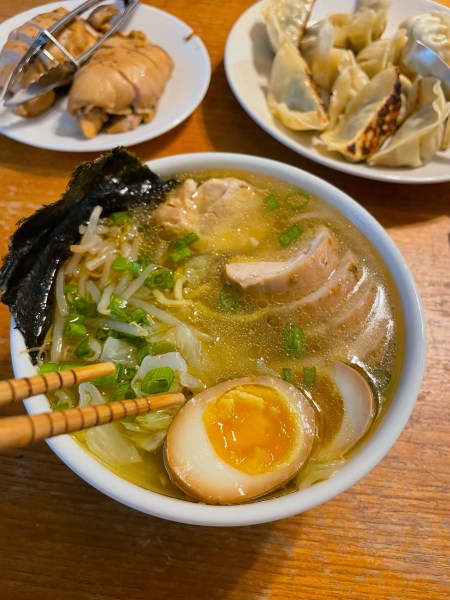
Overall
Hey, so this turned out pretty good. Definitely a bit on the salty side so I would be more careful of adding salty tare in increments, rather than in batches. The broth was pretty flavorful and I was really happy with how the chicken chashu turned out, the meat was moist and flavorful. The soy sauce egg tasted great too.
Probably the most time intensive step was making the broth but I was surprised by how once the broth started simmering, all other components were actually very simple to prep. It just requires some thinking ahead.
It also made me think about how expensive ramen is at some restaurants. I think the broth is probably the most valuable and labor-intensive part of the ramen but the way of making it is pretty simple.
In all, maybe I would make this again, especially as soup weather sets in. I think I would try to speed up the process by making the broth in an Instant Pot though. I’m glad that I got the chance to be a lil extra when it comes to loving my leader and her family.
This ramen is flavorful and it’s soup. That’s really all that I need.

 Things Nicole Tried in 2024
Leave a comment